Next up in my effort to reclaim childhood comfort food is a dish my Engish mother learned to make at St. Olaf’s Catholic Church from Mrs. Maria Norton.
The original is made, as so many one-dish meals of its time were, with Campbells cream of mushroom soup. That was the first change I made since I love making a good cream sauce. Second, the original is topped with both Tater Tots and onion rings. I love browned onions, and I thought that would make a nice upgrade. I’m pretty sure having a non-deep-fried vegetable makes this count as healthy.
About Tater Tots. Don’t substitute something healthier. Just don’t. Eww.
Mom, of course, made this in one big baking dish, but since I still live on my own pending my husband’s move, I made individual servings. This recipe produced enough for five dinner entrées.
Tater Tot Hot Dish
4 tablespoons unsalted butter
3 tablespoons all-purpose flour
2 tablespoons fresh garlic
1 1/3 cup half and half
2/3 cup chicken stock
1/4 teaspoon table salt
fresh ground black pepper to taste
2 large white mushrooms finely chopped
1 large onion chopped
1 tablespoon neutral oil
~1 pound ground beef
1 package OreIda Tater Tots
Melt your butter in a medium sauce pan and saute your garlic for a minute or two over medium heat. Add the flour to form a roux and stir constantly. When the roux begins to darken, or when the aroma changes so that it smells more cooked, remove the sauce pan from heat and add the half and half and chicken stock. Return the pan to a medium high burner and stir constantly until it reaches a rolling boil while being stirred and has thickened. Add the salt, pepper, and chopped mushrooms. Stir to combine and set aside.
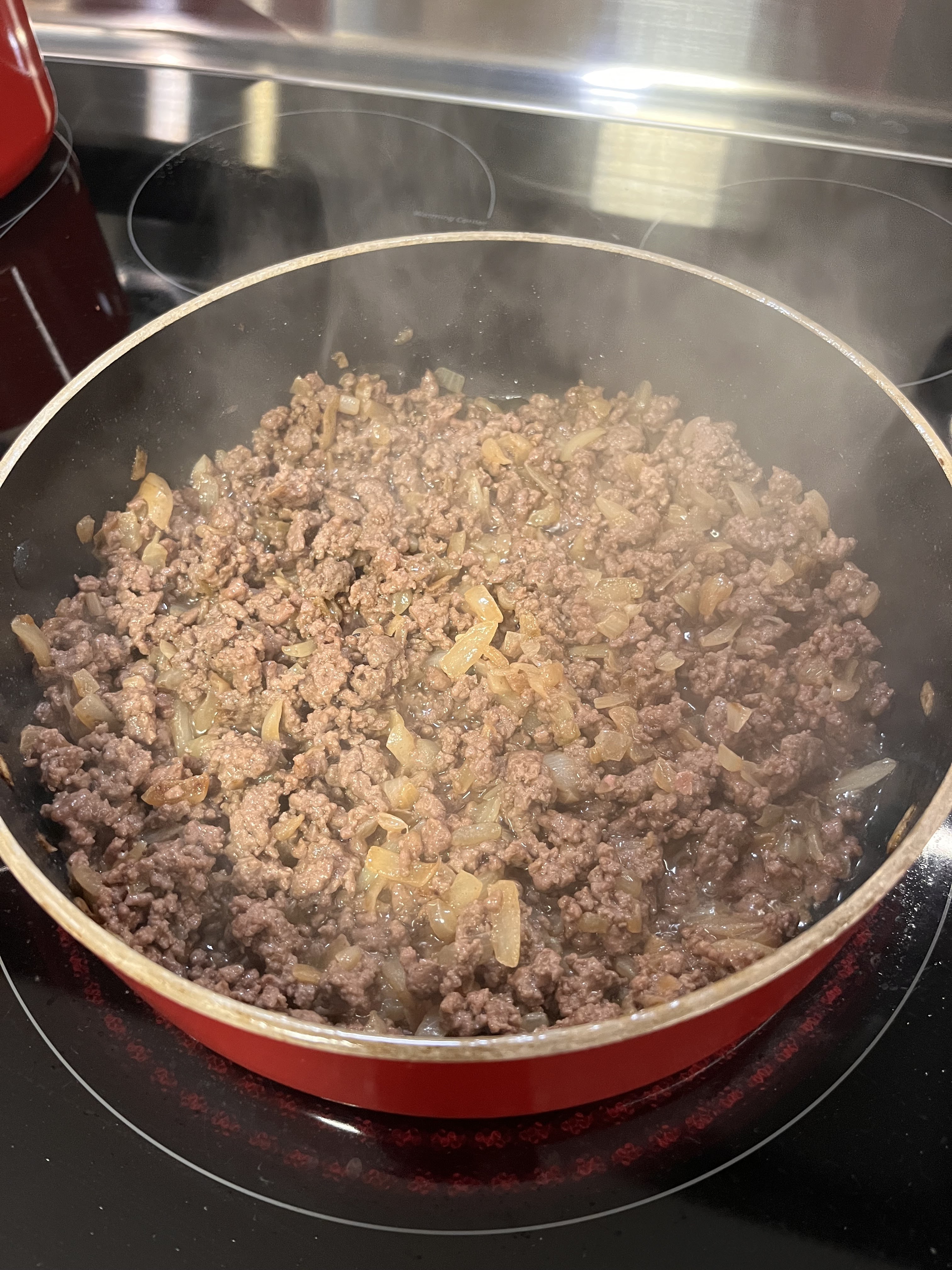
In a large covered saute pan, fry your onion in the neutral oil over high heat while stirring constantly until the edges begin to brown and crisp. Remove from heat and crumble your ground beef. Return the pan to medium heat and cook until the beef begins to brown.
Drain the cooked beef and onion mixture thoroughly. I know, I know. Do it anyway. You’re about to replace the lost yumminess with the mushroom garlic cream sauce. Keep them both and you’ll have a grease pot.
Add the mushroom cream sauce to the drained beef and onion and stir. Add the mixture to individual ramekins, or to an 8 inch square baking dish if you prefer. Add an orderly layer of Tater Tots to the top. Follow the directions on the Tater Tot package to finish your creation.
If you want to make this ahead for later use, just pop the assembled dishes in the freezer with tinfoil over them before the Tater Tots thaw out.
Along with my Scalloped Potatoes with Mushroom and Garlic recipe, this one is another re-invention of a childhood favourite, Tuna Helper! I loved it as a kid, so I decided to make a new version using my grown-up cooking skills. This recipe feeds four adults generously, so cut the quantities in half if you’re feeding fewer people. The cream sauce has a lot of ingredients, but it comes together quickly. It’s worth all the measuring, trust and believe!
3/4 teaspoon salt 1/4 teaspoon black pepper 1 teaspoon dijon mustard
for the casserole
10 oz egg noodles 10 oz canned tuna 10 oz frozen peas 2 cups crushed potato chips
To start the cream sauce, melt the butter of medium heat and sauté the shallots and garlic for about a minute. Add the flour and mix well to form a roux. Stir the roux continuously while it cooks and watch carefully. I’m colorblind, so instructions I received to remove roux from heat when it starts to darken in color were useless to me. Instead, I stop cooking roux when it starts to smell like toast. Either way, when you notice one of those things happen, remove the pan from head and add the cream and chicken stock. If you have drained your canned tuna, you can add the water from the cans as well.
Return the pan to the head and stir continuously until the sauce thickens and reaches a rolling boil. Add the shredded cheddar and stir in. When it is melted and combined, add the salt, pepper, mustard and mix.
Cook the egg noddles per the package instructions and rinse with cold water in a sieve. Slightly undercooking them is a good idea since they will finish in the oven.
Combine the noodles, tuna, and peas in a large bowl, and add the cream sauce. Mix thoroughly, then transfer to a 9 x 12 baking dish. Pour the crushed potato chips over the top and smooth evenly.
Bake the casserole at 375 F for 30 to 45 minutes, depending on how toasty you like your potato chip crust. Allow to cool slightly before serving.
It has been a while since I made any clothes. When the pandemic was looming I thought that I would spend all the extra time at home sewing, but instead I spent it cooking. It's not a bad thing, just not what I expected.
Anyway, after Doug and I got married, we spent two weeks in honeymoon / quarantine on the BC Sunshine Coast, after which we were separated for ten months. Neither of us did particularly well without the other. After some of the restrictions started easing and we could see one another more frequently I was struck with the idea that since we're now legally married, that he could move here and we would no longer be subject to the whims of a nation-state's borders.
That idea and the subsequent weeks of discussion and discernment led to the decision that he would apply for an immigrant visa. The process has been long and daunting, but we're nearly there. In a few days we will leave for Montréal, which is the only place in Canada where the US conducts immigration interviews. There has been drama along the way, but we think we're ready.
Montréal is cold in December FYI. My only quilted jacket was looking a bit the worse for wear, so I decided to make a new one for the trip.
I took my time with the details and did a GREAT deal more hand sewing than I normally would, but this is Montréal. There are expectations. Anyway, I really love it.
Our Mom made a great potato salad, and I’m pleased to say that I’ve managed to recreate the recipe with a few of my own touches. Using the Instant Pot makes it even quicker and a guaranteed success.
Potato Salad
4 cups Yukon gold potatoes
4 eggs
1 cup Kewpie mayonnaise
2 tablespoon sweet relish
2 teaspoon yellow mustard
1 teaspoon rice wine vinegar
1 teaspoon dried dill
1/2 teaspoon
1/4 teaspoon pepper
Peel, cube into bite-sized pieces, and rinse the potatoes. Put about a cup of water into your Instant Pot and place a steamer basket with the potato cubes in. Place the two eggs on top of the potatoes. Cook them for 5 minutes on high pressure and allow about two minutes of natural pressure release before venting.
Cool, peel, and dice the hard boiled egg finely.
Combine the remaining ingredients to make the dressing.
IMPORTANT Do not under any circumstances substitute ordinary mayonnaise for the Kewpie. There is no comparison and no excuse since you can get it at any grocery store with a good Asian food selection, have it delivered by Amazon, or go to an Amazon Fresh. Also, don’t substitute for the rice wine vinegar. Just don’t do it.
Add the dressing to salad and toss very lightly to avoid smushing all the lovely potato cubes.
Place in the refrigerator for a couple of hours to chill for the absolute best result.
This is another fond memory from childhood brought back with a touch of my own sensibilities. The amounts in this recipe are per serving in a 4.5 inch round baking dish. If you make a larger volume you will need to add cooking time.
Scalloped Potatoes with Mushroom and Garlic
Per serving:
1 tablespoon unsalted butter
1 tablespoon all-purpose flour
1 teaspoon finely chopped fresh garlic
2/3 cup heavy cream
1/3 cup chicken stock
1/4 teaspoon salt
1/8 teaspoon ground black pepper
1 white mushroom
1 teaspoon chopped chives
~1/2 Yukon gold potato (about 120 g)
Melt the butter in a sauce pan over medium heat. Add the garlic and sauté for about one minute. Add the flour and mix to form a roux. Cook the roux for several minutes while stirring constantly.
When the roux begins to darken in colour, add the cream and chicken stock and stir to blend. Add the salt, pepper, and chives. Dial the heat up to medium high and continue to stir while the mixture thickens. When it begins to boil, remove it from the heat and add the mushroom. The mushroom will cook just enough while the sauce cools to give the whole mixture a rich mushroom flavour.
Peel the potato and slice carefully using a mandoline slicer. Put a small ladle full of sauce in the baking dish and add your first layer of potato slices. Add more sauce and continue until the dish is full. Cover the last layer of potato generously. I like to add a final touch of freshly ground black pepper to the top.
Place in a pre-heated oven at 325º F for approximately 50 minutes. Check for doneness by inserting a bamboo skewer. When it passes easily through all the layers of potato, it is ready. Remove from the oven and allow to cool for at least 15 minutes before serving. The inside will be like a volcano.
I was born with a flicker of ability It wasn’t enough I learned what I could It wasn’t enough I did what I could It wasn’t enough I taught what I could It won’t be enough Now I am old Now I draw maps You have concerns about the pen I use You have concerns about the ink’s source Have your concerns But take the maps I paid for them with my days
March 16th, 2020 was the last day of the Before Times for me. It was the last day I thought I was going to have an ordinary day working in NOAA’s offices before going home to my beloved Greenwood neighborhood. We got the word late in the day to pack up and take our laptops home and prepare to work remotely for at least two weeks. I hated this idea. I didn’t want to lose the enjoyment of working across from my best friend all day, or going out to lunch, or having casual hallway conversations. I didn’t like the idea of being alone all the time.
I’ll complain and moan for a while when work compels me to do something I don’t want to, but ultimately I know which side of the bread the butter is on, so I soldier up and do what needs to be done. I, my bestie, and his housemate at the time packed up our laptops at the usual time and made our standard goodbye stroll to the parking lot. They walked slow to smoke cigarettes before starting their brutal hour + commute northward. I just enjoyed the chat.
They finished their smokes and it was time to part. Some place of deep knowing inside me opened up and I would have said then that I feared, but really I knew that it was going to be much longer than two weeks before I saw them again.
I started singing. It didn’t feel voluntary.
We’ll meet again. Don’t know where; don’t know when
but I know we’ll meet again some sunny day.
Keep smiling through just like you always do
‘til the blue skies drive the dark clouds far away.
Memories of our mom flooded me. She was a WWII veteran born and raised in England. She often told us that one of the things that got her through the war was Very Lynn’s recording of We’ll Meet Again written by Ross Parker and Hughie Charles. Mom and I would sing it together when I was a teenager while we danced in the living room. She showed me then the power that music has to reach us when nothing else can.
My best friend and his housemate stared at me as I came back from wherever I had gone and started crying.
“Y’ OK?”
“Yeah. Mom used to sing that. It’s from the War.”
I drove home and as I passed through the little business district I think of as ‘downtown Greenwood’ past the restaurants and bars where I spend some of the happiest hours. As I did, the song came out of me again and I felt certain that there would be a shutdown and these places would be dark and silent for an unknown amount of time. It felt like the end of the world.
You can listen to a wonderful rendition of this song by a choral group from England called the D-Day Darlings here:
The second thing that Mom said got her through the war was knowing that then Princess Elizabeth was serving in the military just like she was.
On April 5th, 2020, Queen Elizabeth II made an unprecedented speech about the pandemic. The whole video is worth watching, especially if you are an American who doesn’t understand the value that Her Majesty brings to her people. If you are short on time, though, you can jump ahead to minute four. She makes reference to We’ll Meet Again in encouraging everyone listening to remember that better days are ahead and that we will overcome this problem.
It felt like she was speaking directly to me; or that someone was.
Act II - Sunset Harping and Fae Wiedenhoeft
Inspired by viral videos of musicians in Rome under severe lockdown orders singing and playing instruments from their balconies (sometimes collaboratively with other balconies!) I decided that one small thing I could do was play harp from my own balcony. No one would hear, of course, because it overlooks noisy Greenwood Avenue. My favourite time of day to be here at my condo is sunset. I have a pretty good view of the Olympic mountains to the west and there are times when the sky is breathtaking. I decided that would be the time of day I would play music. It would give me an anchor, and by following the sunset later and later in the day I would keep myself oriented toward the world beyond my four walls.
I had the idea of doing a Facebook live broadcast of these sunset shows, so on March 21st, 2020 the first episode of Sunset Harping happened. I continued to produce half-hour episodes about four times a week and gathered a surprisingly large and loyal following. The show did what I intended. It gave me a relief from feeling alone and it gave all of us an anchor in each day to stop, breathe, and assess.
By early July, there were some temporary reductions in Covid restrictions, which allowed me to invite guests to be on the show with me. One of them was my friend Fae Weidenhoeft. She is a fabulous singer songwriter who I met when she started taking Gaelic classes in the Zero to Gaelic program and singing in the choir. Fae is a blazing talent and a fabulous human and I was delighted to have her with me on the balcony. Over dinner we discussed what we would do on the show and she brought up We’ll Meet Again. It was one of the songs she wanted to perform on the show and she knew it was special to me, but not why, so I told her.
We started the show off with that number with her on ukulele and singing lead. I had worked out a harmony for some parts, but the song has far too many sudden changes of sharps and flats for a lever harp, so I didn’t play. It was an absolutely magical moment. You can see it here:
Act III - A new instrument and a neglected set of skills
My music career has been thoroughly and happily devoted to the music of the Gaelic-speaking people of Scotland, Ireland, and Nova Scotia. My original education, however, was in classical music at Cornish College of the Arts. It took a while before I really found my feet and started to excel, but I managed it. By the time I graduated, I put together a program for my senior recital that included a very respectable collection of mainstream, challenging pedal harp pieces.
Traditional music by and large, doesn’t call for huge range and full chromatic capability of a classical harp, but is better served by the smaller, portable, more resonant, and less expensive lever harp. I have two artist quality lever harps. One was made for me in Scotland, and the other right here in Seattle. They are wonderful, fulfilling instruments that are perfectly suited for what I have done with them. No complaints there.
Although I had completed my degree in classical music, I never owned my own classical harp. I rented a small one from my teacher and regretfully returned it shortly after finishing my degree. I was soon off and running into the world of traditional music, and my investments belonged in instruments that would serve me there.
In 2011, the World Harp Congress was held in Vancouver BC, and my friend Alys Howe with whom I preformed in a harp duo, got us booked to do a concert of music from Scotland and Cape Breton. It was great fun. While I was there, I also spent a bit of time in the vendors hall looking at all the instruments including the classical harps. A spark of interest grew in me.
It took a decade for that spark to grow into action, but in February of 2021, when I was due to receive my inheritance from my parents, I placed an order for a new Lyon and Healy pedal harp. It arrived near the end of June and it was time for me to dust off a stack of music I hadn’t played in 30 years or more. Although my hands could play all the right strings, on a classical harp you have to move seven pedals at the base of the instrument, each of which has three positions, to get all the sharps and flats. That skill was a bit rusty. Like really rusty.
I had the idea to use We’ll Meet Again as a kind of study piece. I pulled out the sheet music that Fae had given me a copy of and spent an evening working out what all the pedal changes would be to get all the right sharps and flats at the right times. It turns out there were quite a lot, so it has been a great exercise.
It has also given me a way to take ownership of the importance of the song in my life. Mom taught me how to find hope in dark times through her love of that song. Queen Elizabeth told me that things would get better again, and I believed her because she touched the place that song holds in my heart. Fae wanted to know why that song mattered to me, because I mattered to her.
Now I can play We’ll Meet Again whenever I need to remember those things.
This was an improvisation that has received enthusiastic reviews, so I wanted to share it here.
Kanikama Salad
1 seedless cucumber
1 teaspoon salt
8 ounces imitation crab (225g)
1 avocado
4 tablespoons Japanese mayonnaise
1/2 teaspoon rice wine vinegar
1/2 teaspoon mirin
1/2 teaspoon usokuchi or plain soy sauce
1/2 teaspoon wasabi paste
Nori goma furikake
Remove the ends of the cucumber and either compost or save for another use. Split down the middle and use a vegetable peeler to remove a strip of skin down the back of each. Slice into 1/4 inch pieces and place in a freezer bag. Add about a teaspoon of salt and seal the bag. Smoosh the cucumber around and set aside for about 15 minutes.
Crumble the imitation crab into a large mixing bowl.
Peel and dice the avocado into chunks roughly like the size of the cucumber pieces and set aside.
Combine the mayonnaise, vinegar, mirin, soy sauce, and wasabi paste and mix well.
Pour the cucumber pieces into a sieve and allow the water that the salt has pulled out of the cucumber to drain.
Add the cucumber into the mixing bowl with the crab. Add the dressing and toss. Add the avocado pieces and mix very lightly.
Spoon into individual serving bowls and place in the refrigerator if not serving immediately. Sprinkle furikake on the salads immediately before serving.
After a year of making miso soup several times a week, I went in search of a new soup to make and I didn’t have to look far. This is a very popular soup in Japan. It differs from the Chinese version in that the broth is dashi rather than chicken stock, and is thickened with potato starch. Other than the dashi, egg, and flavourings, you can substitute other ingredients such as green onion, mushroom, carrot, etc.
One possible adjustment you may want to make is a hybrid stock of 1/2 awase (mixed) dashi and 1/2 vegetable dashi. Since most dashi is made with seafood ingredients like kelp, anchovies, bonito flakes, etc. it has a strong ocean smell. My husband calls it “essence of low tide.” I love it, but some may find it too prominent without the very strong flavour of miso.
Kakitamajiru
2 cups dashi
1 tablespoon usokuchi or standard soy sauce
1 tablespoon mirin
1 tablespoon sake
1 1/2 teaspoon potato starch
1 egg
1/2 teaspoon dried hijiki seaweed
1/4 cup baboo shoot strips
Place the seaweed in a small bowl with water to rehydrate.
Make a slurry of the potato starch with some water
Bring the dashi to a rolling boil and add the soy sauce, mirin, and sake.
Add the potato starch and cook until the broth becomes clear again and is slightly thickened.
Reduce heat and allow the soup to cool to a scant boil.
Beat the egg in a measuring cup. Place a cooking chopstick on top of the cup resting in the pouring spout. Very slowly drizzle the beaten egg down the chopstick to make the egg flowers. If you run out of room, you can scoot the already cooked egg out of the way with the other cooking chopstick so that most of the time, your egg is going into the dashi rather than already cooked egg.
Remove from heat and cover to let all the egg cook thoroughly.
I made myself some Sukiyaki for dinner last night, so had some of the exquisitely thinly sliced marbled beef left over and was casting about for something to do with it while it was still at its prime. In casting, my eye landed on a container of chashu marinade; the byproduct of making chashu pork during my last ramen week. These things, combined with an abundance of vegetables needing used up inspired me to give this dish a try.
If you’re not a ramen-making person, you can make yourself a small batch of something very much like chashu marinade by combining 1/2 cup soy sauce, 1/2 cup sake, and 1/4 cup sugar. It won’t have the pork belly goodness, but is a fair substitute.
As many Japanese recipes do, this one calls for dashi soup stock. You can buy powders, bags to soak in hot water like a tea bag, or surrender to the siren song of washoku and make your own. Nami will help you.
Niku Soba - 肉そば
2 cups dashi
1 cup chashu or ramen egg marinade
1 teaspoon chili bean paste (toban djang)
~ 10 broccoli florets
1 small carrot
1 green onion
2 leaves green cabbage
~ 10 shimeji mushrooms
1/4 pound sukiyaki beef
1 teaspoon miso
Soba noodles
Bean sprouts
Wash and prepare vegetables. Carrots should be peeled and sliced on the diagonal.
Combine dashi, marinade, and chili bean paste in a donabe or similar sized pot. Heat until the mixture is near boiling. Place broccoli and carrot in the broth and cover. Reduce heat to medium low and simmer for 2 minutes.
Prepare soba noodles according to package instructions.
Add remaining ingredients except for the bean sprouts and simmer for a further 2 minutes.
Using a spoon-sized sieve and chopsticks or spoon, dissolve the miso into the broth. Be sure the broth is well below the boiling point so you don’t kill the live cultures in the miso.
Place noodles in a ramen bowl and ladle soup over it.
As I have spent the last nine months working on my Japanese traditional cooking skills and repertoire, I’ve developed some favourite recipes, and also made some of my own customizations to suit my tastes. This one has become my standard weekday breakfast because it is so quick, easy, and satisfying at the start of a day of work.
Tamago Gohan is a classic Japanese breakfast dish that is simply an egg cracked over steaming hot rice. The heat from the rice cooks the egg as you stir it up. It’s also common to add a splash of soy sauce and sesame seeds or furikake.
In my variation, I soft boil the egg, leaving the yolk liquid, and top it off with a seasoning sauce of my own invention made with soy sauce and miso.
Seumas’ Hanjuku Tamago Gohan
Seasoning sauce
1/2 cup soy sauce
1/4 cup white miso paste
1/4 cup hot chili oil (adjust to your spice preference)
1 dash of sesame oil
Combine the ingredients and blend well. I use an immersion blender to get a thorough result. The miso will settle, and the oil will rise but if you start with a well blended mixture, then a quick shake or stir will get it back in shape to use. The amount above lasts me a week or so.
I keep my seasoning sauce in a squeeze bottle for easy access in the morning.
For the bowl
1 large egg
1/3 cup uncooked short grain white rice
Sprinkle of furikake (I prefer seaweed and sesame)
Thoroughly rinse the rice and combine with 5 ounces of water. I use a Japanese rice cooker that I can set up the night before to have my rice ready when I get up, but stove top will work fine as long as you are careful.
I use my Instant Pot to soft boil my egg in 4 minutes at low pressure with quick release.
Remove the egg immediately and hold under cold running water to cool the shell so you can peel it comfortably. After peeling, just place it in your bowl and bury it in rice.
Sprinkle furikake, and add seasoning sauce.
I like to stab the egg through the rice with my chopsticks to release the delicious egg yolk and let it slowly combine with the rice, but you do you!
 Next up in my effort to reclaim childhood comfort food is a dish my Engish mother learned to make at St. Olaf’s Catholic Church from Mrs. Maria Norton.
 Tater Tot Hot Dish
 In a large covered saute pan, fry your onion in the neutral oil over high heat while stirring constantly until the edges begin to brown and crisp. Remove from heat and crumble your ground beef. Return the pan to medium heat and cook until the beef begins to brown.