Friday, November 13, 2015

Project 49: Boys Underwear

Nine pairs of colorful boys underwear
Nine pairs in the picture, but one didn't pass inspection.
Yes, those are my toes.
A friend of mine has a young son who had a kind of rough start in life medically speaking, but he's doing well now and is the most adorable, cherubic lad you could imagine. He does, however, have some challenges and one of them is skin sensitivity. The poor kid and his lovely Mum have a terrible time finding underwear that's comfortable.

I became aware of this back when I did my big production run of mens underwear for me and Doug. My friend wondered if the simple design combined with the very smooth, very soft bamboo jersey might be the key to solving the problem for the young man. I made him a sample pair, and they did the job. He could finally be comfortable all day.

This last week I was finally able to carve out enough time to do a production run for him, so tomorrow he's getting eight pair of super-comfy Taigh Sheumais Fashions boys trunks. Cheerful colours, colour blocking, and contrasting stitching because who wants boring underwear?

Thursday, September 17, 2015

Project 48: Union Jack Shirt

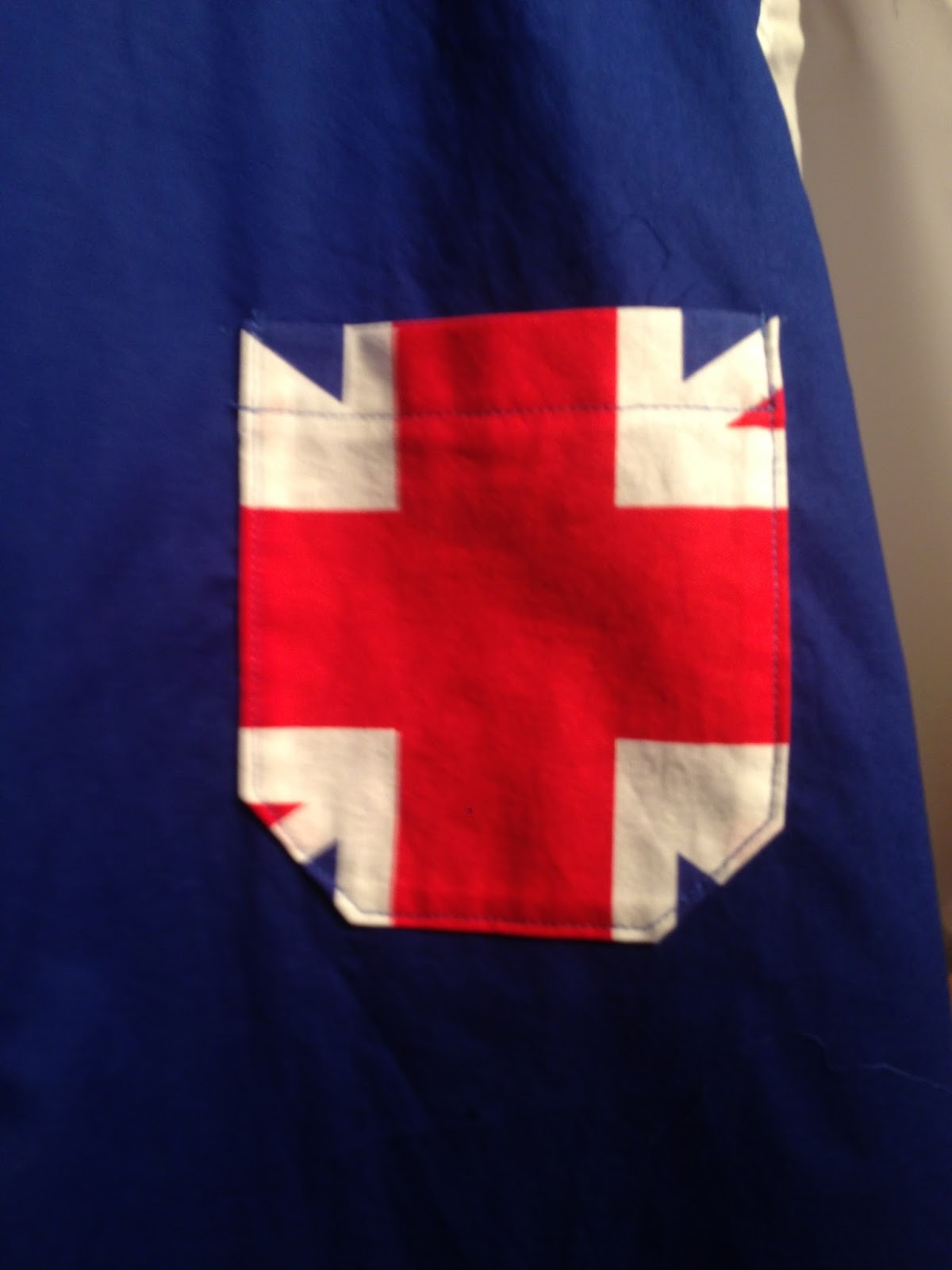
 The third and final of my flag-themed shirts, the Union Jack. I really got excited about this design when Google revealed to me that I could order fabric from the Union Jack Shop with the Union Jack printed on it for the pocket. Making the DIY maple leaf was challenging enough, thanks!

I've executed this pattern enough times that I don't usually encounter any construction issues anymore. Mishaps, however, still happen. I rarely work with white fabric, so didn't really think about it when I pricked my finger with a pin and drew blood. Oops. I suppose a blood stain is appropriate for any imperial power's flag.

Being color-blocked, it was inevitable that some of the top stitching would be contrasting to the fabric, so I decided to use up some of my left over blue thread that was slightly lighter than the blue fabric. I like the fact that all of the top stitching is visible, rather than just where it crosses a white area.

I also completed the project from cutting to buttons in two evenings, down from a typical three for a shirt like this one.


Wednesday, September 16, 2015

Retirement

The following is an open letter to the membership of our Gaelic society, Slighe nan Gaidheal regarding my decision to retire from the Board of Directors after 18 years of service.

Mo Shoraidh Slan Leibh (fad greis)

My Fond Farewell To You (for a while)

Back in 1995 when the guys in my Scottish Gaelic class with Richard Hill started organizing events together I could not have imagined the joys, the challenges, and the love that the next twenty years would bring into my life. I have been called upon to grow as a student of Gaelic and it's history and culture, as a community organizer, and as a human being and I know that growth will serve and sustain me for the rest of my life.

Three years ago, when I decided that I was running for my last term on the Board of Directors this day seemed a distant dot on the horizon, but here it is. Deciding to retire wasn't easy, and last Monday evening when a new season of Seirm started without my help it was strange. Good, but strange.

I was one of the original incorporators back when we started Slighe nan Gaidheal in 1997, and there were a couple years of work before that also, so all told, I have served this community as an organizer for twenty years without a break. I have life goals that are sitting basically idle and I’m hoping that I’ll be able to accomplish some with the time I’ll have back by retiring from the Board, the Communications Committee, and the Gaelic Music Committee. I will continue to teach through the Zero to Gaelic program, though, so if you miss me, come sign up!

Working to help build Slighe nan Gaidheal the organization and its community is without a doubt the most important thing I've ever done, and it has been hugely rewarding. The opportunity to meet and learn from our many tradition bearing presenters over the years is something that I will be grateful for forever. Just as importantly, knowing, working with, and sharing time with all of you has made my life into so much more than I ever thought it would be. Thank you.

Together we have built something extraordinary and precious. Féis Seattle, Seirm, and Zero to Gaelic are models that other communities are already starting to emulate. I know that whatever challenges may lie ahead, Slighe nan Gaidheal is strong and resilient enough to make it through with all of our help and the continuing leadership and dedication of our Board of Directors. It is especially comforting that our first president and another person who signed the incorporation documents, Richard, is back on the Board and steering the way to a bright future for our organization.

While I won't be involved in Slighe nan Gaidheal's day-to-day operations for the foreseeable future, I will most certainly be working hard for Gaelic in our region. Doug and I are already involved in the launch of Guth nan Eilean's inaugural season of their program, Conversational Gaelic, and we hope to be able to provide some organizational assistance to other groups as well.

Sharron Gunn and I at Folklife circa 1998
So it's really not farewell, it's just see you in different contexts. If you want to stay in touch, you can join my musician page on Facebook: https://www.facebook.com/seumasgaelicmusic

Or sign up for my e-mail newsletter: http://mail.seumasgagne.com/mailman/listinfo/friends_seumasgagne.com

Chí mi sibh uile a-rithist!

Seumas

Sunday, August 9, 2015

Project 47: True North Shirt

After making my Old Glory Shirt for the gig in Vancouver on Independence day last month, I decided I wanted to try my hand at a couple more flag-themed shirts. Here's the second one in the series for my beloved second home, Canada.

I had some beautiful red poplin in my stash that I purchased at Mood Fabrics, so I went shopping at my local Pacific Fabrics store for some matching white and found a pretty good pairing.

The first challenge was making the pocket with the maple leaf. I decided to to full-on DIY. I purchased a package of Steam-a-Seam sheets, which are essentially two sheets of paper with a layer of fabric glue between them. I was really happy to read in the instructions that they are pinter-safe! With a quick Google search I found a vector graphic of the Canadian flag which I was able to re-size and print onto the sheet. I then peeled off the blank side of paper, stuck the fabric on it, then carefully cut around the maple leaf. I then peeled the printed side of paper off and voila! a very tidy iron-on maple leaf.

I determined during my last project that my pattern piece for the collar stand was about an inch too long for the neck opening, so in that one I shortened the stand piece, In this one, however, I increased the size of the neck opening and I like it much better because I button the top button on this shirt easily. Yay!

I also re-drafted the collar piece to make it a little smaller, which I think looks more modern. I really like it.

Monday, July 27, 2015

Project 46: Japanese Print Aloha Shirt


Shiny!
Remember the post about Doug's splendid aloha shirt that I made with fabric we bought while on Maui? Well, I bought some fabric for myself that day also, and now just three years later I've gotten around to making my shirt!


It's a beautiful medium weight 100% cotton poplin and the manufacturer's website describes the print as: "A metallic gold lined dreamscape of patterned fans, Japanese yew, Iris and crane silhouettes flow diagonally over a solid ground." I loved it instantly.

I used the same pattern as my Old Glory shirt, but corrected a pattern drafting error in the original; the stand collar was about a half an inch too big for the neck.

The pattern matching went pretty well, though I did wind up abandoning a completed set of right and left side fronts because I realized I had matched the pattern at the facing fold line instead of the center front. Luckily, I usually buy more fabric than I need because I make these kinds of mistakes.

There is one chuckle-worthy mistake in the whole garment and the first person to figure it out and leave it in a comment gets a big gold star.

I kind of like the big, retro collar.


Nailed the box pleat.
Can you see the pocket?
Enjoy the view as I stroll away.

Friday, July 3, 2015

Project 45: Old Glory Shirt


We have some friends here in Vancouver, who each independently found Doug and I for help working on their Scottish Gaelic. They are both musicians; Robyn is a professional music teacher and singer and Daibhidh is an ardent practitioner of rap and is becoming a fabulous singer also. We introduced them to each other and a natural alliance emerged. They formed a band called Can Cala and are working on their first recording project as I write this.

Earlier this year, they asked me if I would be interested in opening a gig for them at Skinny Fat Jack's and I accepted enthusiastically. The best date that was available, however, was Saturday, July 4th. What a delicious bit of irony, I thought to myself. Go to Canada to sing Scottish Gaelic songs on U.S. Independence Day. How to make it even better? Transform into Taigh Sheumais Fashions and get sewing!

Box pleat preserves stripe pattern
Initially I thought I would make myself a casual shirt out of some fabric with a US flag design on it, so when I got an e-mail from Pacific Fabrics announcing a sale on patriotic themed fabrics, I headed right in. What I found on the rack, though, inspired a new design. There were two different prints by the same textile artist. One was white stars on a blue field, and the other was red and white stripes. What was really appealing about it to me, though, was that they weren't exact matches to the flag. The red and white stripes were mottled, and the white was really more of a parchment color which also invokes the thought of the founding documents to me. The blue field behind the stars is also mottled and the stars themselves are askew rather than on a grid.

Facing enclosed by yoke shoulder seam
I got out my McCalls M4399 to use as a base and started drafting the pattern pieces. Stand collar, yoke with center box pleat, and short sleeves. Fronts back and yoke out of the stripes, collar, sleeves and pocket out of the stars. Two new tricks in construction; first, when constructing the collar, I left the two ends of the collar stand unfinished until I had fit it to the neck opening to be sure the end of the band would match perfectly. Second, I folded the front facing into place and basted at the neck so that when I attached front pieces to the yoke on the back, the raw edges of the facing were enclosed in the yoke shoulder seam. So much tidier than hand stitching them in place later!

Now I just need to get a Canadian flag lapel pin so I don't get killed on stage tomorrow night.

Sunday, June 7, 2015

Another Chance to Say Thanks

The Quick Shuttle, which we have been using for the last fourteen years to get Doug back and forth between Vancouver and Seattle has temporarily changed their pickup location from the Best Western by the Seattle Center to the Washington State Convention Center on Pike street. No one, unfortunately, told me that when I made his reservation to get back home tonight, so thirty minutes after his bus was supposed to depart, I started to worry.

Checking on their website, we figured out what had happened and hopped in my car to zoom over to the new pickup location. There was one more departure tonight, so we anxiously waited for the bus to arrive, hoping that there would be a seat available for him, and that the driver would take my word for it that we had a reservation on the previous bus.

While we were waiting, a familiar face walked past us in the crowd.

"Doctor Savage?" I called out.

He stopped and looked at me, obviously trying to figure out who I was.

"I don't know if you'll remember me…"

"Of course I do, Mr. Gagne. Are you still playing the harp?"

Dr. Savage and I had a sometimes tense relationship when I was studying with him at Cornish College of the Arts back in the 1980s, but there was an underlying respect that grew into a warm teacher / student friendship by the time I graduated. He was my professor in several subjects including opera chorus, cultural history, music history, and more. The things I learned from him changed the course of my musical life in many positive ways.

Dr. James Savage
We quickly caught up with the basic outline of life. He had just retired after 33 years as the music director at Saint James Cathedral. I introduced him to Doug and told him about my complete immersion into Scottish Gaelic music and culture. It seemed we were about to part company, so I gave him my card.

"Since Fate has given me this opportunity…" I began.

He got a funny, apprehensive look on his face. Had other previous students found him years later and been negative?

"I want to say thanks. Thanks for everything you taught me. Thanks for the foundation you gave me. It has served me well."

He beamed. We hugged. He said it was the best feeling in the world to hear that from a former student. Then he looked past me to Doug.

"I'm allowed to do this because I couldn't when he was a student."

He kissed my cheek. Tenderly, sweetly, and we parted ways.

Doug's bus arrived, and the driver believed our story, and there was a seat for him on the bus.

"I think that was why this happened." I said as I kissed him goodbye.

Friday, May 22, 2015

Leaving Folklife

The first time I attended the Northwest Folklife Festival I was fifteen years old. I found out about it when I played my very first harp gig at the opening of an Irish restaurant on Bainbridge Island on St. Patrick's Day in 1981. Two other local harpers also played that gig, the late Ron Konzak and the very much not-late Karen Bruner. They both told me I should go, so I did.

For those of you who don't know, Folklife is a four-day festival that takes place each year on Memorial Day weekend at Seattle Center. Stages are set up all over the grounds and thousands of volunteer performers apply to be a part of it.

Not too long before my first
time performing at Folklife.
It's not an exaggeration to say that Folklife changed the trajectory of my life, though I had already found my direction. I was instantly surrounded with other traditional and folk musicians from whom I could learn. A smörgåsbord of instruments to try, handicrafts, clothes, food, dances, and everywhere fascinating people! There was even a particular tree under which Witches (there weren't any other kinds of Pagans around then) gathered. When I went back home to the farm, I had new eyes to see with. I knew there was another world waiting for me.

The following year I performed at Folklife for the first time. It was at the stage set up next to the Kobe Bell. Some of my high school friends came, and before too many more years, attending Folklife was the official start of Summer.

That was thirty three years ago. Once or twice I missed the festival entirely, but usually I went. After that first performance, I didn't apply again until the formation of my band, Wicked Celts. We performed every year during the band's lifetime. By the time the it was winding down, Slighe nan Gaidheal was starting to fill up my calendar, so our musical group, Seirm, would keep me getting up on stages at Folklife. I never once had an application rejected.

In 2012 I released my first solo CD, and started looking for opportunities to perform so I could promote the recording and make some progress toward resurrecting my solo career. I applied to Folklife and was accepted. I even got a pretty good time slot.

The next year I applied again, and got a mediocre time slot and had the absolute worst sound engineering experience of my life. The stage was awash in feedback the entire show. Folklife 2013 was a nightmare for me.

Then, in 2014, the part of Seattle Center where Folklife programmed most of its British Isles content was going to be under construction and unavailable. This is the year I will always think of as The Blood Bath. My application was rejected, along with many, many of my best musical friends. We were all upset, but tried to give Folklife the benefit of the doubt and soldiered on.

Then, as if by fate, I found myself the recipient of a pair of complimentary tickets to a fabulous concert by Le Vent du Nord. Doug and I went, and we hadn't been in our seats too long before our hosts introduced us to another beneficiary of their generosity. The individual had only just left a position at Folklife that involved making application decisions, so before I could stop myself, I asked "So, what was up this year?" The individual hesitated a moment, then said: "Oh. You're that Seumas." Bingo.

The individual related the official Folklife narrative about how the usual British Isles content stage was unavailable and how only some of the customary acts could be accommodated on other stages... If they had stopped there it might have worked, but they didn't. After all, they continued, the British Isles genre did have a much higher acceptance rate than any other genre so leveling the playing field... [over to my inner voice] ...was an opportunity to cut the second rate acts who were just getting in for the sake of Celtic coolness... [back to the outer world]

I had been cut as a second-rate act. It was a bitter pill to swallow.

Since then, I've had plenty of time to think back over the last three plus decades of supporting Folklife and realized that there has been an evolving pattern of change from my first experience of the festival. Some examples:

  • There used to be one big hall of vendors where artists and craftspeople of all kinds, including instrument vendors were housed. First the instruments were taken out and isolated in a musical instrument emporium, then they were eliminated. That's right: you can't buy a fiddle at Folklife anymore.
  • Sandy Bradley used to run a musical instrument auction, which was a fantastic opportunity for musicians to sell unwanted instruments, and for aspiring folks to buy them; sometimes at excellent prices. Sandy retired. Folklife stopped holding the auction.
  • Folklife used to sell your CDs for you all weekend. Now you can set up a table next to your stage if you have someone to staff it for you while you perform.
  • Electric instruments used to be excluded from Folklife. Now they blare across the Seattle Center and drown out the traditional music.
  • There used to be a performer's appreciation party on the Saturday evening of the weekend held at a nearby venue with many spaces for musicians to mix and meet each other. Now it's held in the same hospitality barn that's open to performers all weekend. There's no additional effort made whatsoever.
  • Performers have long enjoyed having the instrument check-in room, and that continues today, but it's run by the local scouting council for tips, not by Folklife.
  • This year, performers were reminded that they are not allowed to use Seattle Center bathrooms to change in and out of performance attire. I plan on taking off my kilt in the lobby of the theatre.
I'm sure that every single one of these changes was for a Good Reason™, but from my perspective, each of them was a small step away from Folklife being an event at which traditional and folk musicians could find and inspire each other and a step toward what it is today. Last year, when I was still stinging from my first rejection e-mail I complained about the change in direction and an individual who had in years past been in a program management position with the festival stated "Folklife isn't a folk music festival! It's a community festival!" The irony was apparently completely lost on him.

Almost certainly my last performance at Folklife in 2013
In my opinion, Folklife sold its soul to preserve its life, and is well on the way to becoming the kind of villain that that choice typically produces.